What a five-second test can tell you about your next twenty years
This is a hand dynamometer:
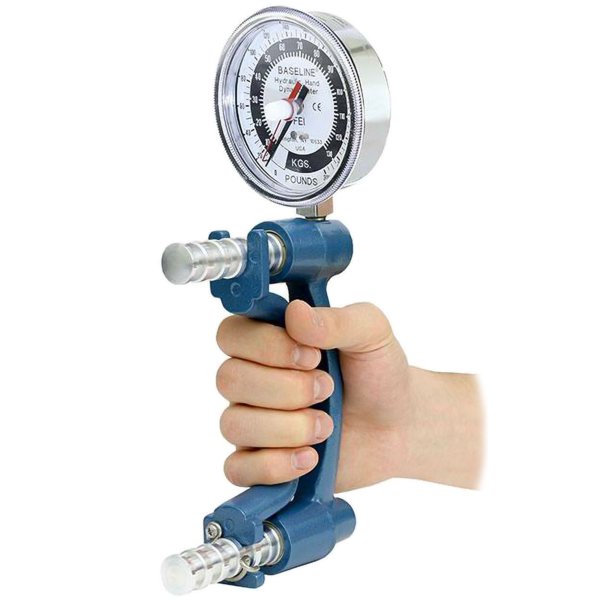
It looks like a prop from a 1970s doctor's office, and it's extremely simple to use: you squeeze it as hard as you can for about five seconds. The score is a single number, in pounds or kilograms. The whole test, both hands, is over in about thirty seconds.
Yet that dynamometer result predicts how long you'll live better than your blood pressure. One large study found it tracked cardiovascular disease more closely than the amount of exercise people reported getting. In terms of testing ROI, it's nearly impossible to beat.
A Quick Note of Sanity Up Front
Squeezing a spring gripper at your desk isn't going to add years to your life. (Grip strength has been getting a lot of airtime in the longevity world lately, which is exactly why it's worth saying.)
Grip strength is an excellent approximation of your current health and strength, which makes it a great read out on where you stand. But grip strength isn't what's actually driving that health, and just improving grip likely won't have meaningful positive impact on your longevity. Understanding that difference is a main focus of this post, because it changes what you actually do based on your dynamometer result.
What the Number Predicts
In 2015, a study in the Lancet followed 140,000 people in 17 countries, collecting a slew of measures over time. One of the measures was grip strength, which turned out to be surprisingly predictive of health: every 5kg drop in grip strength came with a 16% higher risk of dying from any cause over the follow-up, and a 17% higher risk of dying from cardiovascular disease specifically. Grip was a stronger predictor of death than even blood pressure, the number doctors most often track for assessing cardiovascular health. A later study of half a million people in the UK Biobank found the same thing, and then some: grip tracked cardiovascular disease more closely than blood pressure or how much exercise people reported doing.
And the predictive value of a dynamometer score reaches further than just a few years. In 1999, a study in JAMA looked at grip readings from 6,000 healthy Japanese-American men in Honolulu, aged 45 to 68, taken in the mid-1960s, then compared those readings with the same men's health a quarter-century later. Men in the weakest third at midlife were roughly twice as likely to have trouble taking care of themselves in old age as the men in the strongest third. They were also far more likely to be slow walkers, or unable to get up out of a chair without using their arms.
What It Doesn't
Grip strength is a proxy. In and of itself, it isn't doing much to determine how long or how well you'll live. But it does reflect a bunch of other things that do: how much muscle you're carrying, how well your nervous system can fire it all at once, and the overall size of your physiological reserve (the margin between what an ordinary day demands and what your body can produce when pushed).
Muscle is metabolically active tissue. It's the account you draw down on during illness, injury, and aging. A strong grip is a decent sign your account is full. A weak one usually means your muscle mass, neural drive, and physiological reserve are heading the wrong way: a trajectory that ends with you on a walker, or stuck full-time in bed.
That said, there's also real research on the limitations of grip strength as a single proxy for whole-body strength. You can have a strong handshake and chicken legs. That's why, in our programming, we test and retest a broad array of strength and power measures with our clients. But as a cheap, fast, single-number flag for "is this person's strength and muscle heading the wrong way?," nothing else in a standard workup comes close.
What Counts as a Good Number
There's reasonable consensus on the point at which grip strength is an active problem: the European Working Group on Sarcopenia defines anything below 27kg for men and 16kg for women as the screening threshold for probable sarcopenia, the age-related wasting of muscle and strength.
But that's a floor, not a target. Clearing 27kg at 55 isn't "good." It's "the alarm bell isn't ringing, yet." Healthy, trained men in midlife tend to land somewhere around 45–55kg and women around 27–35kg, with a lot of honest variation by hand size, dynamometer model, and how carefully the test is run (one more reason the measurement conditions matter as much as the measurement).
Regardless, the useful question isn't just whether you're above the floor; it's how much margin you carry above it, and which way the trend is moving over time. For a man, a 52kg grip at 50 gives you plenty of runway to stay above the threshold at 75. A 30kg grip at 50 clears the threshold today, but leaves you with almost nothing to lose.
What to Do About It
If your grip comes back low, your next step shouldn't be training your grip. You can, and it "works": dedicated grip training will raise your dynamometer score by something like 10-30% in a couple of months. But it won't buy you any of the more important things the score was standing in for. You'll have a firmer handshake, but the same muscle mass, the same physiological reserve, and the same health and longevity odds as you did before. In other words, you'll have gamed the proxy, instead of working on the underlying factors that actually matter.
Instead, the answer is improving strength and building muscle everywhere: picking up weight, carrying it around, hanging from (or pulling up to) bars. That means working out, specifically the kind of heavy compound work that forces your legs, back, arms, and hands to cooperate under real load. (That's a big part of what we help clients figure out, with a particular focus on hyper-personalizing to their unique experience level, goals, limitations, etc.) Do that for a few months and your grip climbs as a side effect, because now it's reporting on a body that genuinely changed. Don't chase the number but the thing underneath it, and the number inevitably follows.
What a Real Measurement Gives You
The actual test is almost insultingly simple: a calibrated dynamometer, a standard seated position, a couple of maximal squeezes per hand, best score recorded. Thirty seconds. What makes it worth doing in a lab rather than on the $19 gadget you'd buy after reading this is the same thing that makes any of these measures worth doing properly: a clean baseline, on a reliable and accurate device, taken the same way every time, plotted against norms for your age and sex, and then repeated over time. One reading tells you where you stand. The second and third, a training block or two later, tell you whether what you're doing is working.
At A3, grip is part of a single-morning workup that also clocks your VO2max, your resting metabolism, your body composition, and how you move (the whole single-visit picture we mapped out in Part 1). Grip is the simplest line item in that workup by a wide margin, but also one of the most predictive. The combination is rare enough to be worth the squeeze.
Your doctor probably hasn't measured most of this. We will.